
The Acadian Diaspora
Introducing Heather Cox Richardson's 250 to 250

I talk a lot about Kentucky here. And Florida, too. But central to my story, and remaining close to my heart is the town of Breaux Bridge, Louisiana. We moved there when I was only three so my stepdad could work on the oil rigs in the Gulf of Mexico. Mom was only 20 back then; she likes to say we grew up together. Joining us was my younger brother, along with my aunt and uncle, the latter of whom also worked offshore.
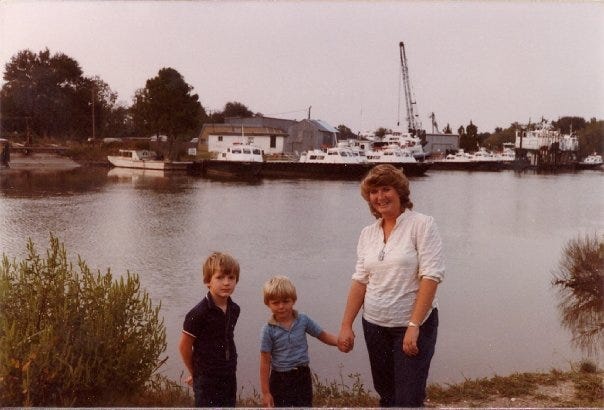
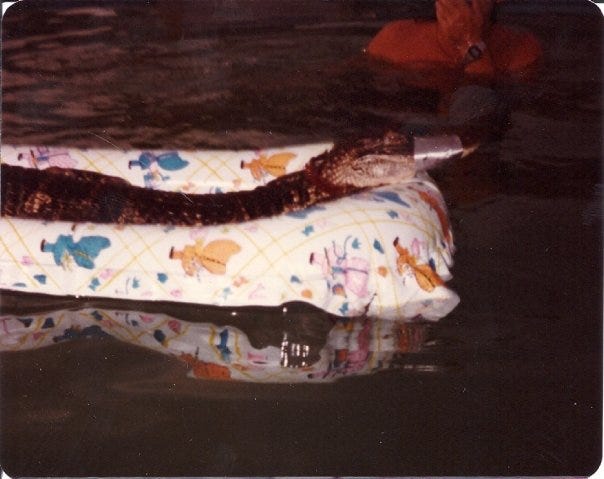
All but one of my earliest memories are from Louisiana, and it was there that a child named Jason Herbert quickly became Jason Hebert. Like most of the kids in St. Martin Parish, I grew up speaking (though not quite perfecting) the patois that is Cajun French. I remember catching sac-a-lait (crappie) in the bayous and trying to release as many crawfish as I could before they ended up in a boil. On occasions we'd visit with friends who had a pet alligator that we'd swim with.
We had a babysitter. I asked my mother her name once, but she couldn’t recall. All we knew was that we called her Mom Da. Mom Dah watched six or seven of us, all around four or five years old. When we misbehaved, she’d make stand on our knees behind the couch and stick our tongues out. Then she’d put a spoonful of her homemade hot sauce on them. We did not misbehave often. I remember it was with Mom Dah that I killed my first chicken. I was five. She told me to go and catch one in the backyard and hold it upside down until it stopped moving. I watched her dispatch that bird, pluck it, and cook it. This was life in Louisiana in 1982.
Mom’s maiden name was Chadwick, so combined with my father’s Herbert meant that I was pretty much the most English-descended kid roaming the bayous. But our neighbors’ names told different stories. We were enveloped by folks named Guidry, Thibodeaux, Boudreaux, LeBlanc, and Fontenot. My first crush was my childhood friend, Schlacey Broussard.
Those names told of a different time, a different origin. Because like me, true Cajuns came from someplace else once upon a time. But their world—the accordions playing Zydeco, the crawfish boils, the kitchens that smelled of a brick roux and cayenne—might be the most American of them all.
If you haven’t picked up on it by now, Heather Cox Richardson and her team are producing small snippets of Americana in celebration of this country’s enduring history. Some are about people, other are places. Some you know of, others maybe you should know. In fact, let me let Heather tell you more about it:
So when Heather asked me if I’d want to contribute a little something on my adopted home, I said mais oui! And well, here you go:
If you click on either video, you’ll get the chance to watch others like them from such people as Pete Buttigieg, Jon Tester, Ariana DeBose, Jelani Cobb, and others, with even more to come. Check it out, because I think it’s a really cool project and I’m glad to have a little part in it.
Here’s a link to follow along on Substack:

You can also follow along across all the social media platforms by searching for 250to250 or the hashtag #WeAreAmerica250.
Oh, and I’ll pop back in with some more stuff on the Cajuns a bit later, but for now, take a look at some of those videos and lemme what you think.
Jason
And hey- if you enjoy pieces like this—stories about memory, history, identity, film, the outdoors, and the strange paths that make us who we are—consider becoming a paid subscriber. Paid subscriptions help support the writing, the podcast, Historians At The Movies, and the time it takes to keep telling these stories. Plus, you’ll get access to subscriber chats, watch parties, and the deeper dives that don’t always make it onto the public page. Merci, y’all.
I read Hodson's The Acadian Diaspora a few years ago after you recommended it, and really enjoyed it. Neat to see this snippet now!
Love the series, reminds me of the Bicentennial minutes in 1776 when I was a high school senior. One comment, please ask HR to redo the text about the Zenger trial and freedom of the press, narrated by Jelani Cobb. It's incorrect in two ways: the "Framers of the Constitution" did not write what became the First Amendment; in fact they voted unanimously by state delegations to defeat the Mason-Gerry resolution to add one at the Constitutional Convention in 1787. Due to insistence by Antifederalists during state ratification conventions, the First Congress in 1789 passed what became known as the Bill of Rights, and that document had two other amendments listed before what we now know as the First Amendment. Those first two failed ratification in 1791, but one of them is now the 27th Amendment. Facts matter, now more than ever. One can say that the First Amendment is important, is now listed first in the Bill of Rights, but not that the "Framers" wrote it or that they placed it first among the others. The people did, on both accounts.